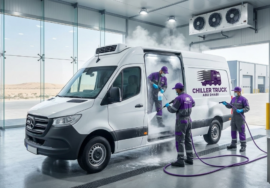

What Is a Chiller Van? | Chiller Van vs Freezer Van | UAE Guide
Understanding the Chiller Van: Your Gateway to Cold Chain Logistics
If you are in the food, pharmaceutical, or logistics business in the UAE, you have likely heard the term chiller van countless times. But what exactly is a chiller van, how does it differ from a freezer van, and why is it so essential for businesses operating in the extreme heat of Dubai and Abu Dhabi?
In this comprehensive guide, we will explain everything you need to know about chiller van technology, the critical differences in a chiller van vs freezer van comparison, what chiller temperature Dubai regulations require, and how chiller van transport keeps your temperature-sensitive cargo safe. We will also touch on the larger what is a chiller truck question for businesses needing greater capacity.
Whether you are a restaurant owner, pharmaceutical distributor, logistics manager, or business owner exploring cold chain options this guide is for you.
What Is a Chiller Van? Definition and Basic Function
A chiller van is a light commercial vehicle (typically a Toyota Hiace, Mercedes Sprinter, or similar van) that has been fitted with a mechanical refrigeration unit. This unit actively cools the cargo area to maintain temperatures typically between +2°C and +8°C the range required for fresh food, dairy, pharmaceuticals, and flowers.
Unlike a standard delivery van, a chiller vehicle uses insulated walls (usually 50-100mm polyurethane foam), a sealed cargo door, and a roof-mounted or under-slung refrigeration unit powered by the van’s engine or a separate standby motor.
The key characteristics of a chiller van are:
- Active refrigeration: not just insulation; the unit actively removes heat
- Temperature control: adjustable to specific setpoints within the chiller range
- Insulated body: prevents external heat from entering
- Temperature monitoring: digital sensors track temperatures throughout transit
In the UAE, where summer ambient temperatures regularly exceed 50°C, a chiller van is not a luxury it is a regulatory requirement for commercial food transport.
Chiller Van vs Freezer Van What Is the Difference?
One of the most common questions in cold chain logistics is the chiller van vs freezer van distinction. While both are refrigerated vehicles, they serve completely different purposes.
Chiller Van
| Feature | Detail |
| Temperature Range | +2°C to +8°C |
| Typical Cargo | Fresh food, dairy, produce, flowers, pharmaceuticals |
| Cargo State | Chilled, not frozen |
| Best For | Short-to-medium term preservation (days, not months) |
| Example Uses | Supermarket milk delivery, restaurant fresh ingredients, flower transport |
Freezer Van
| Feature | Detail |
| Temperature Range | -18°C to -25°C |
| Typical Cargo | Frozen meat, ice cream, frozen vegetables, seafood |
| Cargo State | Frozen solid |
| Best For | Long-term preservation (months) |
| Example Uses | Ice cream distribution, frozen meat transport, seafood export |
The Key Difference in Simple Terms
The chiller van vs freezer van difference is simple: a chiller vehicle keeps things cold but not frozen (think refrigerator at home), while a freezer van keeps things frozen solid (think home freezer). A chiller van is for fresh products that would be damaged by freezing lettuce becomes limp, milk separates, flowers wilt. A freezer van is for products that require frozen storage meat, ice cream, frozen vegetables.
Some businesses need both. A catering company might use a chiller van for fresh produce and dairy, but a freezer van for frozen meat and ice cream. We offer both options in our fleet.
Chiller Temperature Dubai What Does the Law Require?
Understanding chiller temperature Dubai regulations is critical for any business transporting food in the emirate. Dubai Municipality (DM) sets strict temperature requirements for different food categories.
Standard Chiller Temperature Dubai Requirements
| Food Category | Required Temperature |
| Fresh dairy (milk, yogurt, cheese) | +2°C to +5°C |
| Fresh meat and poultry | 0°C to +4°C |
| Fresh fish and seafood | 0°C to +2°C |
| Fresh produce (vegetables, fruits) | +4°C to +8°C |
| Prepared meals and deli items | +2°C to +5°C |
| Pharmaceuticals (general) | +2°C to +8°C |
For Abu Dhabi, ADAFSA regulations mirror these requirements but add additional documentation and driver certification (EFST).
A properly equipped chiller vehicle can maintain any temperature within the +2°C to +8°C range. The key is that the refrigeration unit must be rated for the UAE’s extreme ambient heat. European-rated units (designed for 25°C-30°C ambient) will fail during Dubai’s summer. UAE-specified units are rated for 50°C+ ambient.
How Does a Chiller Van Work?
A chiller van operates on the same basic principles as a domestic refrigerator, scaled up for commercial use and mobile operation.
The Components of a Chiller Vehicle
- Insulated Cargo Box: Walls, floor, and ceiling are filled with high-density polyurethane foam (typically 50-100mm thick) to prevent heat transfer.
- Refrigeration Unit: Mounted on the roof or front wall of the cargo box. Contains a compressor, condenser, evaporator, and expansion valve.
- Power Source: Most chiller van transport units are driven by the van’s engine via a belt-driven compressor. Some larger units have standalone electric standby for when the van is parked.
- Digital Temperature Controller: Allows the driver to set the desired temperature. A sensor inside the cargo box continuously monitors actual temperature.
- Data Logger: Modern chiller vehicle specifications include digital temperature logging. The system records temperature at set intervals (typically every 5-15 minutes) and can produce a report for HACCP or GDP compliance.
The Refrigeration Cycle Simplified
- The compressor pressurises refrigerant gas, heating it
- The hot gas passes through the condenser (outside the cargo box), releasing heat to the outside air
- The gas cools and condenses into a liquid
- The liquid passes through an expansion valve, rapidly cooling and turning back into a cold gas
- The cold gas passes through the evaporator (inside the cargo box), absorbing heat from the cargo area
- The cycle repeats
The result: heat is continuously pumped from inside the cargo box to the outside atmosphere, keeping your cargo cold even when external temperatures exceed 50°C.
What Is a Chiller Truck? The Larger Alternative
While a chiller van is perfect for loads up to 1,000 kg, some businesses need more capacity. So, what is a chiller truck?
A chiller truck is the larger sibling of the chiller van. It is a heavy commercial vehicle (3-ton to 10-ton payload) with a larger insulated cargo box and a more powerful refrigeration unit. Chiller truck specifications typically include:
| Feature | Chiller Van | Chiller Truck |
| Payload | 800 kg to 1,200 kg | 2,500 kg to 10,000 kg |
| Cargo Volume | 5 to 8 cubic metres | 12 — 50 cubic metres |
| Typical Use | Urban multi-stop routes | Bulk distribution, inter-emirate |
| Pallet Capacity | 1-2 pallets | 6-20 pallets |
| Tail Lift Option | Rare | Common |
Choose a chiller van for lighter loads, multi-stop urban routes, and locations with limited access (narrow streets, basement parking). Choose a chiller truck for palletised bulk cargo, supermarket restocking, and inter-emirate distribution.
Who Uses Chiller Van Transport in the UAE?
Chiller van transport serves a wide range of industries across Dubai, Abu Dhabi, and the northern emirates.
Food and Beverage Distribution
The largest user of chiller van services is the F&B sector. Restaurants, cafes, hotels, and supermarkets rely on daily chiller van transport for fresh ingredients, dairy, and prepared foods.
Pharmaceutical and Healthcare
Clinics, hospitals, and pharmacies need chiller vehicle services for medicines, vaccines, and lab samples that must remain within strict temperature ranges.
Florists and Flower Wholesalers
Fresh flowers are highly temperature-sensitive. Florists use chiller van transport to move blooms from warehouse to shop or directly to customers for weddings and events.
Catering and Events
Catering companies preparing food off-site rely on chiller van transport to deliver meals to corporate events, weddings, and airline catering facilities.
E-Commerce Cold Chain
The rapid-delivery grocery sector uses chiller van fleets to restock dark stores and deliver temperature-controlled meal kits directly to consumers.
Benefits of Renting a Chiller Van vs Buying
For many businesses, renting a chiller van is more cost-effective than purchasing and maintaining your own.
Advantages of Renting
- No capital expenditure: avoid AED 80,000-150,000 purchase cost
- No maintenance: refrigeration units require regular servicing; we handle it
- No driver recruitment: we provide trained, certified drivers
- No compliance headaches: we maintain ADAFSA/DM certification
- Flexibility: scale up during peak seasons, scale down during slow periods
When Buying Makes Sense
- Daily, year-round usage (300+ days per year)
- Very specific vehicle customisation requirements
- You already operate a fleet and have maintenance capacity
For most SMEs, a chiller van rental with driver is the most cost-effective and hassle-free solution.
Chiller Temperature Dubai: Summer Challenges
Maintaining chiller temperature Dubai standards during summer is challenging. Here is why UAE-specified equipment matters.
The Problem with European-Spec Refrigeration
European refrigeration units are designed for ambient temperatures of 25°C-30°C. During a Dubai summer, the unit’s condenser is trying to release heat into 50°C+ air. The temperature differential is much smaller, making the unit work harder and less efficiently.
The Solution: Gulf-Spec Equipment
UAE-specified chiller vehicle refrigeration units have:
- Larger condensers for better heat dissipation
- Higher-capacity compressors
- More powerful fans
- Tropicalised components resistant to heat and humidity
Our entire chiller van fleet uses Gulf-spec equipment, calibrated quarterly to maintain ±0.5°C accuracy.
Frequently Asked Questions About What Is a Chiller Van?
Q1: What is a chiller van in simple terms?
A chiller van is a delivery van with a built-in refrigerator that keeps cargo cold (typically +2°C to +8°C). It is used to transport fresh food, medicine, flowers, and other temperature-sensitive items, especially essential in the UAE’s extreme heat.
Q2: What is the difference in a chiller van vs freezer van?
In the chiller van vs freezer van comparison: a chiller van keeps products cold but not frozen (+2°C to +8°C) for fresh items like dairy, produce, and meat. A freezer van keeps products frozen (-18°C to -25°C) for ice cream, frozen meat, and seafood. Choose based on your cargo.
Q3: What chiller temperature Dubai requires for food transport?
Chiller temperature Dubai requirements vary by food type: dairy (+2°C to +5°C), fresh meat (0°C to +4°C), produce (+4°C to +8°C). A chiller vehicle must maintain these temperatures even when external temperatures exceed 50°C. Dubai Municipality enforces these standards.
Q4: What is a chiller truck and how is it different?
When asking what is a chiller truck, the answer is a larger refrigerated vehicle (3-ton to 10-ton payload) for bulk distribution. A chiller van handles up to 1,000 kg; a chiller truck handles palletised cargo for supermarket restocking and inter-emirate routes.
Q5: Can a chiller van be used for frozen goods?
No. A standard chiller van maintains +2°C to +8°C, not freezing temperatures. For frozen goods, you need a freezer van (-18°C to -25°C). Some chiller vehicle providers offer dual-temperature vans, but these are less common and more expensive.
Q6: Is a driver included in chiller van transport rental?
Yes. At Chiller Truck Abu Dhabi, every chiller van transport rental includes a professional, EFST-certified driver. For Abu Dhabi food routes, drivers hold food handler certificates. Self-drive chiller van rentals are not offered for compliance and insurance reasons.
Q7: How long does a chiller van stay cold with the engine off?
*A properly insulated chiller vehicle will maintain temperature for 60-90 minutes with the refrigeration unit off, depending on external temperature. However, for food safety compliance, the refrigeration unit should run continuously during transport. Modern units automatically restart when the engine starts.*
Q8: What is the cost to rent a chiller van in Dubai or Abu Dhabi?
Chiller van rental starts from AED 350/day for a Toyota Hiace with driver and fuel included. Monthly contracts start from AED 5,800/month. Compare this to purchasing a chiller vehicle (AED 80,000-150,000) plus maintenance, driver salary, and compliance costs.
Q9: Are chiller vans ADAFSA certified for Abu Dhabi?
Yes. A chiller van operating in Abu Dhabi must carry an ADAFSA FWD Mobile Food Establishment Permit. Our entire fleet is ADAFSA certified. For Dubai, we carry DM Cards. Always verify certification before booking chiller van transport.
Q10: What is the ideal chiller van for UAE conditions?
*The Toyota Hiace is the most popular chiller van in the UAE due to its reliability, parts availability, and maneuverability. For chiller temperature Dubai compliance, ensure the refrigeration unit is Gulf-spec (rated for 50°C+ ambient), not European-spec.*
Ready to Rent a Chiller Van for Your Business?
Now that you understand what is a chiller van, the chiller van vs freezer van difference, and chiller temperature Dubai requirements, you are ready to make an informed decision for your cold chain logistics.
Whether you need chiller van transport for daily restaurant deliveries, a chiller vehicle for pharmaceutical samples, or want to understand what is a chiller truck for bulk distribution our team is here to help.